


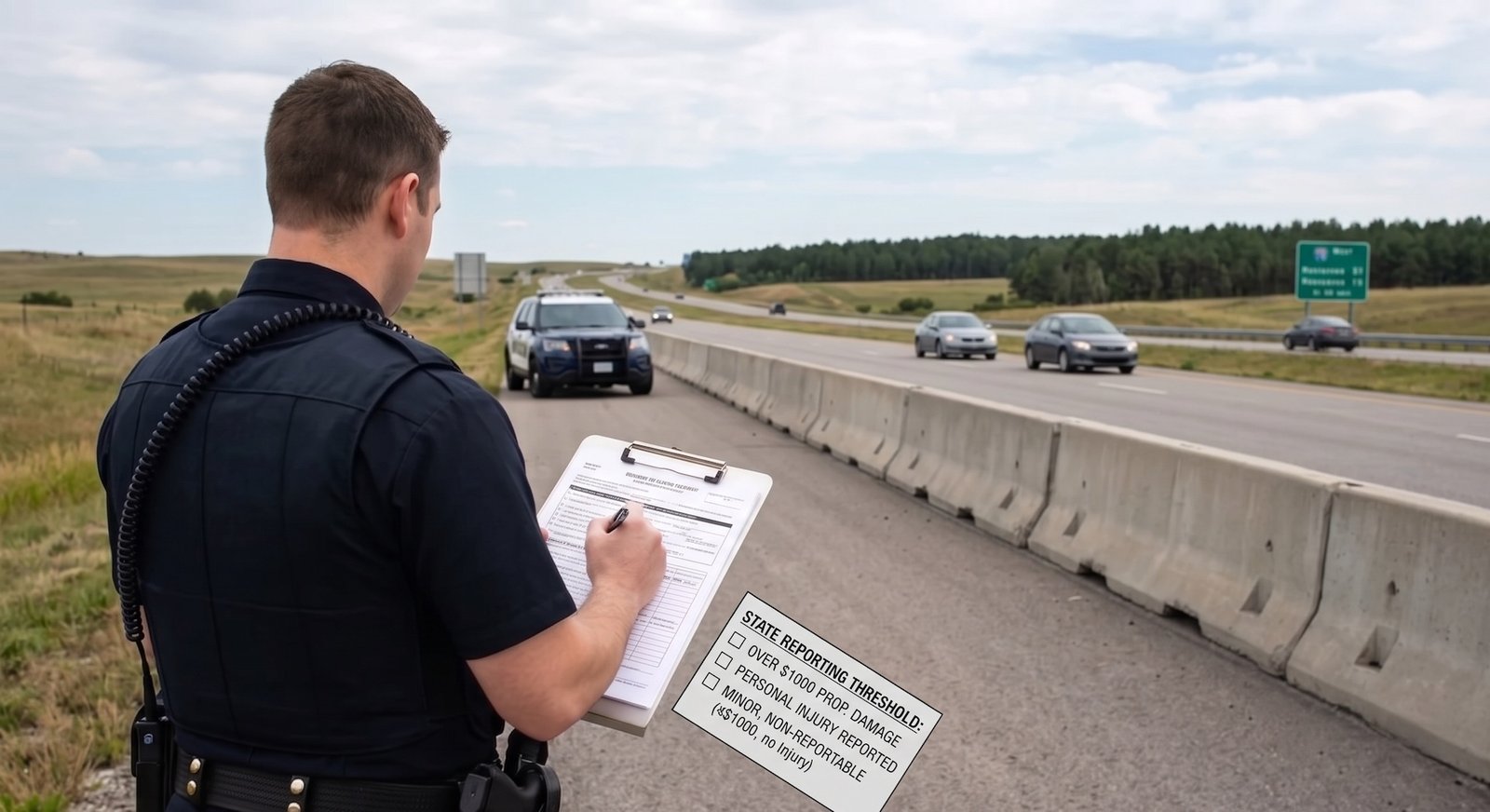
Why Reporting Thresholds Matter for Your Legal Claim
Meeting the reporting threshold is not just a legal formality. It has direct consequences for a car accident injury claim or property damage claim you may want to make after an accident.
If an accident meets your state’s reporting threshold and you fail to file the required report, you may face penalties – and it can complicate or undermine your personal injury claim. At the same time, a properly filed police or crash report creates an official record of what happened:
- The facts
- The parties involved
- Any traffic violations
- Who was at the scene
- Potential witnesses
That record is often the foundation of a successful compensation claim.
What If I Was in An Accident that Doesn’t Meet My State’s Reporting Threshold?
You should still file a police report.
Even if the law doesn’t require it, a police report establishes an independent factual record of the accident. Without one, the other driver can later change their story. With one, your attorney has a foundation to work from if you later make an injury claim.
For a full breakdown of what to do after a minor accident – including what to say, what to document, and why you should call a lawyer before your insurer – read our post on what to do after a minor car accident.
What If I Feel Fine and Don’t Have Any Symptoms of Injury?
It’s common to experience pain, stiffness, or other symptoms hours or even days after the accident – even if you felt completely fine at the scene.
Adrenaline masks injury, and soft tissue damage in particular can take time to surface. If you want to protect your right to make an injury claim, you must seek medical attention after the accident.
A police report strengthens that injury claim. It documents the circumstances of the crash independently of either driver’s account, which matters when you’re trying to establish that your injuries were caused by the accident and not something else.
$140,000 Settlement After a Low-Impact Collision in Woodbridge, Virginia
Our client was stationary at a stop sign when a vehicle approaching from the right turned too sharply and struck the front of her car. The impact was to the bumper – no ambulance was called, and our client felt well enough at the scene that emergency services didn’t seem necessary.
Police attended, issued an incident number, and facilitated the exchange of information between both parties.
In the days that followed, she began experiencing neck and back pain, headaches, and nausea. Her partner took her for a medical evaluation, and she was prescribed medication to manage her symptoms. Her insurance company offered $1,200.
She called Rodriguez Law Firm and won a $140,000 settlement.
Takeaway: The police report in this case did exactly what it’s supposed to do – it created an independent record of the crash that neither driver could later dispute. It gave our attorneys the foundation they needed to challenge a lowball insurance offer and secure a result that reflected the real impact of the accident.
To see what results are possible after accidents of all kinds, view our full settlements and verdicts page.
Car Accident Reporting Requirements by State
The threshold listed for each state refers to the estimated cost of property damage at or above which a formal crash report is legally required. In most states this means filing with the state DMV, law enforcement, or both.
Some states also impose separate deadlines – for example, requiring an immediate verbal report to police and a written report within a set number of days.
Here’s the table with linked source text:
| State | Minimum Reporting Threshold | Official Source |
| Alabama | $2,000 | Source |
| Alaska | $2,000 | Source |
| Arizona | $2,000 | Source |
| Arkansas | $1,000 | Source |
| California | $1,000 | Source |
| Colorado | $1,500 | Source |
| Connecticut | $1,000 | Source |
| Delaware | $250 | Source |
| Florida | $500 | Source |
| Georgia | $500 | Source |
| Hawaii | $3,000 | Source |
| Idaho | $1,500 | Source |
| Illinois | $1,500 | Source |
| Indiana | $1,000 | Source |
| Iowa | $1,500 | Source |
| Kansas | $1,000 | Source |
| Kentucky | $500 | Source |
| Louisiana | $500 | Source |
| Maine | $2,000 | Source |
| Maryland | All crashes must be reported — no minimum threshold | Source |
| Massachusetts | $1,000 | Source |
| Michigan | $1,000 | Source |
| Minnesota | $1,000 | Source |
| Mississippi | $500 | Source |
| Missouri | $500 | Source |
| Montana | $1,000 | Source |
| Nebraska | $1,000 | Source |
| Nevada | All crashes must be reported immediately — no minimum threshold | Source |
| New Hampshire | $1,000 | Source |
| New Jersey | $500 | Source |
| New Mexico | $500 | Source |
| New York | $1,000 | Source |
| North Carolina | $1,000 | Source |
| North Dakota | $4,000 | Source |
| Ohio | $1,000 | Source |
| Oklahoma | $500 | Source |
| Oregon | $2,500 | Source |
| Pennsylvania | Must report immediately if there is death, injury, or a vehicle is rendered undriveable — no damage-amount threshold | Source |
| Rhode Island | $1,000 | Source |
| South Carolina | $1,000 | Source |
| South Dakota | $1,000 to one person’s property, or $2,000 total across all property | Source |
| Tennessee | Report immediately if damage exceeds $50; written report required within 20 days if damage exceeds $400 or there is death or injury | Source |
| Texas | $1,000 | Source |
| Utah | $2,500 | Source |
| Vermont | $3,000 | Source |
| Virginia | $3,000 | Source |
| Washington | $1,000 | Source |
| West Virginia | $1,000 | Source |
| Wisconsin | $1,000 (or $200 if government property is damaged) | Source |
| Wyoming | $1,000 | Source |
NOTE: All data and links accurate at time of publication.
What If Your Accident Is Below the Reporting Threshold?
A crash that falls below your state’s mandatory reporting threshold still has legal consequences – for both your insurance claim and any potential personal injury case.
You still need to stop and exchange information. In every US state, drivers involved in an accident involving property damage or injury must stop, remain at the scene, and exchange contact, licence, and insurance information with the other party. This applies regardless of how minor the accident appears.
You should still file a police report. Even if the law doesn’t require it, a police report establishes an independent factual record of the accident – the time, location, parties involved, and any observed violations. Without one, the other driver can later change their story. With one, your attorney has a foundation to work from.
You should still get a medical evaluation. Many injuries from car accidents – particularly soft tissue injuries like whiplash – don’t appear immediately. Getting a medical evaluation within 14 days of the accident creates a clinical record linking your symptoms to the crash. This is essential if you later decide to make a claim.
What Happens If You Don’t Report an Accident That Meets the Threshold?
Failing to report a qualifying accident can result in fines, licence suspension, and in some states, criminal charges. It can also create problems for your insurance claim, since insurers may question why the accident wasn’t officially reported. If you’re unsure whether your accident meets your state’s threshold, treat it as though it does and report it.
Speak to a Car Accident Attorney Before You Decide Anything
Understanding your state’s reporting requirements is one piece of the picture. Whether you have a viable claim – and how much that claim could be worth – depends on the specific facts of your accident, the evidence available, and how quickly you act.
To find out more, I recommend you speak to a car accident attorney.
At Rodriguez Law Firm, we offer a free, confidential, no-obligation consultation. We’ve recovered compensation for clients whose accidents looked minor at the scene – including a $140,000 settlement for a client who was offered just $1,200 by their insurance company.
If you were involved in a car accident that was not your fault, contact us today for a free case review.