


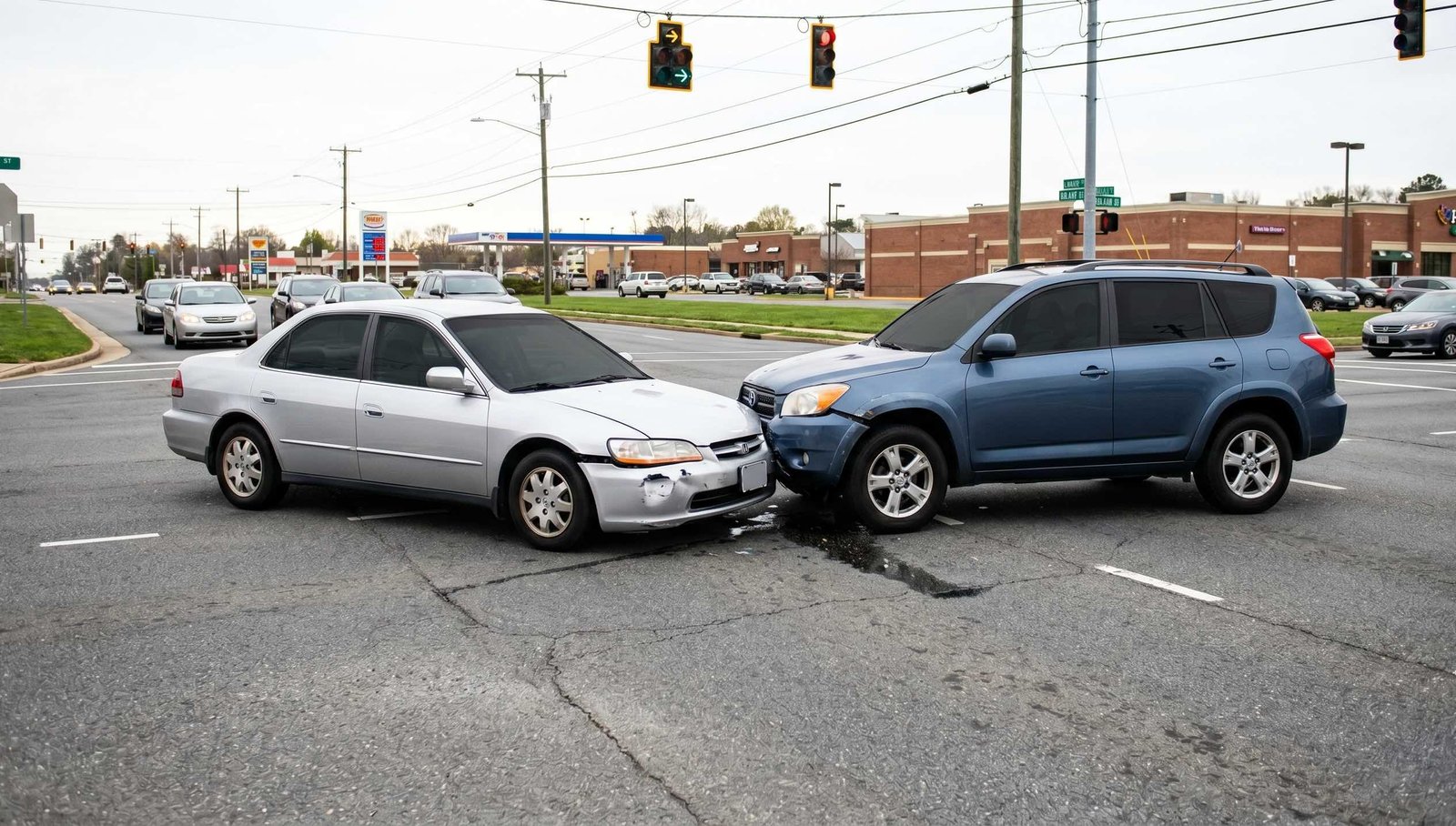
Can you still win a settlement if you didn’t feel injured at the scene?
Many people believe they can’t make a personal injury claim after a minor car accident.
But that’s not fully true.
I recently saw this firsthand. Our client was stationary at a stop sign when a vehicle struck their car head-on, and damaged the front bumper. There were no ambulances called and no immediate injuries reported.
But a few days later, our client began to experience neck, back, and muscle pain.
Rodriguez Law Firm ended up securing a $140,000 settlement.
This result serves as proof: a “minor” accident can lead to injuries that take a while to show up.
In this post, I’ve detailed the seven steps you need to take right now to protect your future. If you start to experience injuries in the coming weeks, this post could become very valuable.
How to get an expert’s opinion on your right to make a claim
It’s normal to feel confused over your right to make an injury claim. I want you to know you can always contact an attorney at Rodriguez Law Firm for a free case review to understand your legal standing, before making any decisions.
Join more than 1,100 clients who have rated Rodriguez Law Firm five stars. Request a free, confidential, no-obligation consultation with an attorney today.
Request your free case review here
What Counts as a Minor Car Accident in the US?
Before we get into the seven steps, let’s take a look at the laws around “minor” accidents in the US.
There’s currently no legal definition for a “minor” collision.
Most states measure accident severity by the estimated cost of property damage. In Virginia, where we have two offices, state law requires a formal police report when total property damage is $3,000 or more.
Reporting thresholds vary significantly across the US. In some states the threshold is as low as $250. In others it’s as high as $4,000. Maryland and Nevada require drivers to report every crash, regardless of the damage amount. We’ve put together a full breakdown of car accident reporting requirements for all 50 states if you want to check the reporting threshold for your state.
What does this means for you?
An accident that looks minor may still trigger legal reporting requirements under your state’s law.
For example, a cracked bumper or a dented door can reach several hundred dollars in repair costs. That can be enough to require a formal report.
Virginia law also allows any person involved in an accident resulting in injury or property damage to file a written report to the Commissioner.
I recommend treating every accident as significant, no matter how small it appears.
Do I still have to stop and exchange details following a minor accident?
Yes, you need to stop and exchange details in every US state, without exception.
If any property is damaged or anyone is injured, you must stop and exchange information with the other driver.
This applies even when the damage is very small.
Under Virginia Code § 46.2-894, any driver involved in an accident must stop and provide their name, address, driver’s licence number, and vehicle registration number to the other party and to law enforcement.Failing to do this is a serious legal offence in every US state.
I will explain exactly what information to collect in Step 4.
7 Steps to Take After a Minor Car Accident
This post is written for people whose accident was not their fault. These 7 steps will help you protect your right to compensation – and protect yourself if the other driver later decides to take action against you.
Follow every step, even if you do not plan to make a claim.
Skipping them could cost you later.
Step 1: Check yourself for injuries first
Before you do anything else, check your body for pain or injury.
Adrenaline masks pain. You may feel fine in the first few minutes and wake up the next morning unable to move. I’ve seen this happen to many of our clients.
Once you’ve checked yourself, check your passengers.
Step 2: Call 911 if you are in pain or injured
If you feel pain anywhere – in your neck, back, head, chest, or anywhere else – call 911.
Many people are afraid to call an ambulance because of the cost.
I understand this fear.
But I tell every client the following: call for help, get the care you need, and then call a lawyer.
A lawyer can pursue the at-fault party’s insurance to cover all your medical bills and other expenses. Many personal injury attorneys – including us at Rodriguez Law Firm – work with networks of doctors who can provide ongoing treatment at no upfront cost while your case is in progress.
Do not let fear of cost stop you from getting emergency care.
Also, I recommend you do not call your insurance company before getting medical care.
I’ll explain why in Step 7.
Step 3: Call the police
Call the police after every car accident – even when it seems minor.
The law does not require a police report in every state for every minor accident. But I still recommend it.
That’s because a police report creates an official record of what happened. It captures the facts, the people involved, and any traffic violations – such as running a red light or speeding. That information supports a compensation claim and makes the process faster and easier.
Without a police report, the other driver can change their story.
But a police report establishes the facts of the case and often contains everything a lawyer needs to make a successful claim on your behalf.
Do not try to decide whether the accident is serious enough to justify calling. Call the police.
Step 4: Stay at the scene and exchange information
Never leave the scene before exchanging details with the other driver. In every US state, leaving the scene when property has been damaged or someone has been hurt is a serious offence.
Under Virginia Code § 46.2-894, for example, you must provide the following to the other party and to law enforcement:
- Your full name
- Your address
- Your driver’s licence number
- Your vehicle registration number
That is the legal minimum.
But I recommend you go further and use your phone to photograph:
- Their driver’s licence
- Their insurance card
- Their insurance company name and policy number
- Their vehicle make, model, and colour
This information is the foundation of any compensation claim, so collect as much as you can while you are still at the scene.
Step 5: Document the scene
While you’re still at the scene, take photos.
Photograph the damage to both vehicles and the position of the cars on the road, as well as any nearby road signs, traffic lights, or skid marks. Look for surveillance cameras on buildings or traffic poles – ask if you can get a copy of the footage.
If there are witnesses, ask for their names and phone numbers – a witness statement can make a real difference if the other driver later denies responsibility.
Evidence disappears fast. Get it while you’re there.
Step 6: Get a medical evaluation (within two weeks)
I can’t stress this enough:
Get a medical evaluation within two weeks (14 days) of the accident – even if you feel fine. Not sure whether to go to the hospital or what happens if you can’t afford it? Read our full guide here.
This is not optional if you want to protect your case.
Under Federal Rule of Evidence 803, medical records are only considered reliable evidence when they are made close in time to the incident.
If you wait too long, the defence can argue that your injuries were not caused by the accident. They can also argue that your records were created for a lawsuit, rather than for genuine treatment. Both arguments weaken your case.
Around 90% of a personal injury case is built on documented injuries. No documentation means no case.
I hear the same concerns from people often – they have no insurance or can’t afford medical treatment.
I understand.
But these are not valid reasons to skip this step.
Many personal injury attorneys – including at Rodriguez Law Firm – can connect you with doctors who will treat you while your case is in progress, at no upfront cost to you. We can also recover all the costs of medical expenses.
But you need that first evaluation before anything else can happen.
Step 7: Call a lawyer (before you call your insurance company)
Once you have received medical attention, call a lawyer.
Do not call your insurance company first.
I know this sounds strange. But your insurance company is not there to maximise your payout. They are there to protect their own interests, which can mean minimising yours. If you call them before speaking to a lawyer and say the wrong thing, it can damage your claim.
Remember the $140,000 compensation claim I mentioned at the beginning? The client’s insurance company offered only $1,200 to cover the related medical costs.
Three Cases Where Rodriguez Law Firm Secured Compensation After a Minor Accident
It’s easy to wonder whether a minor accident is worth pursuing. These two cases show what is possible, even when injuries are not serious.
Case 1: $140,000 settlement for a car accident in Woodbridge, Virginia
Our client was stationary at a stop sign when a vehicle approaching from the right attempted to make a left turn. The driver executed the turn too sharply and struck her car head-on, impacting the front bumper.
Police arrived at the scene, issued an incident number, and facilitated the exchange of information between both parties.
No ambulance was called. Our client felt well enough in the moment that emergency services didn’t seem necessary.
But in the days that followed, she began experiencing neck and back pain, headaches, and nausea.
The client’s partner took her for a medical evaluation. The client was prescribed medication to manage symptoms. She called her insurance company and was offered $1,200.
Then she called Rodriguez Law Firm and won a $140,000 settlement.
Two things stand out in this case:
- Delayed symptoms are common after car accidents
- A lowball opening offer from an insurer is not the final word
Case 2: $100,000 settlement after a collision in Midland, Virginia
Our client was driving in his lane on an early winter morning in Midland, Virginia. A car coming from the opposite direction hit an ice patch, lost control, and struck the front of his vehicle.
The other driver got out and accepted fault on the spot. Police attended the scene and confirmed in their report that the defendant was responsible. Our client was taken to hospital in an ambulance, where doctors ran X-rays.
They found no serious injuries – but he felt pain across his chest, back, left knee, and pelvis.
The defendant’s insurance accepted liability and made an offer. The client did not accept it.
He called us at Rodriguez Law Firm instead.
We secured a $100,000 settlement on his behalf – for property damage.
The lesson is clear: never accept the first offer from an insurance company without speaking to a lawyer first.
Case 3: $10,700 settlement for minor injuries in a rideshare accident in Arlington, Texas
Our client and his family were travelling by Lyft in Arlington, Texas. The driver was distracted – he was looking down at his phone – and failed to notice a semi-truck merging into traffic.
The vehicles collided.
The drivers exchanged details but didn’t call the police.
Our client then contacted Lyft, who opened a claim with their insurer. Soon after the client and family members began to experience neck, back, and muscle pain – soft tissue injuries that do not always show up on an X-ray but can affect daily life.
We secured a $10,700 settlement for the family.
Two things stand out in this case:
- Soft tissue injuries are worth pursuing
- Even without a police report, a compensation claim is possible – though a police report strengthens your position
Read about other settlements our clients have made here.
Frequently Asked Questions
Will My Insurance Premiums Go Up If I Make a Claim?
This is one of the questions I hear a lot. People are afraid that making a claim will cost them more in the long run.
The honest answer is: it depends.
The main factors are whether the accident was your fault, whether you have a history of prior accidents or traffic violations, and what your insurer’s individual policy says. For example, a driver with a clean record who was not at fault is in a very different position from someone with prior claims.
That said, I have seen insurance companies raise premiums even when my client was not to blame.
Some insurers view any involvement in an accident as a financial risk, regardless of fault. In those cases, I’ve seen premiums rise by around $5 to $10 per month, based on my direct experience with clients.
But here’s the reality: $5 to $10 more per month is nothing compared to the compensation you can receive. When the at-fault party’s insurance covers your medical bills, your lost earnings, your rehabilitation costs, and every other expense caused by the accident, the difference is clear.
There’s also something called ‘accident forgiveness.’
Many US insurers offer this as part of their policy. If you have a clean record, the accident was not your fault, and you have no prior claims, your insurer may not raise your premiums at all.
Progressive and Allstate both offer accident forgiveness programmes. State Farm has a similar policy, though it often only applies after nine years with no accidents on record.
Check your policy or call your insurer. If you’re unsure, speak to a lawyer before you decide anything.
What should I avoid doing after a minor accident?
Knowing what to do matters. Knowing what not to do protects your case.
- Do not admit fault at the scene. Never say sorry or accept responsibility at the scene, even in passing. Fault is a legal determination. It is decided by lawyers, insurers, and courts – not by what you say in the minutes after a collision. Stay calm, be polite, and say nothing about who was responsible.
- Do not leave the scene. Leaving before you have exchanged details with the other driver is a serious offence in every US state. Leaving early can be treated as a hit-and-run offence, with serious legal consequences.
- Do not call your insurance company before speaking to a lawyer. Your insurer will ask you to describe what happened and what you say in that first conversation can affect the outcome of your claim. A lawyer can prepare you for that conversation or handle it on your behalf.
- Do not delay medical attention. Every day you wait without seeing a doctor weakens your case. Get your evaluation within 14 days. Do not give the other side that opening.
What compensation can I claim after a minor car accident?
If the accident was not your fault, you may be entitled to claim for:
- Property damage: the cost to repair or replace your vehicle
- Personal injuries: physical harm suffered in the accident
- Medical bills: emergency care, hospital visits, and follow-up treatment
- Medical rehabilitation: physiotherapy, ongoing care, and recovery costs
- Lost earnings: income you were unable to earn because of the accident
- Loss of future earnings: if your injuries affect your ability to work long term
- Emotional distress: the psychological impact the accident has had on your life
- Any other costs you incurred as a direct result of the accident
The amount you can recover depends on the evidence you have and the specifics of your case.
Get a Free Case Review at Rodriguez Law Firm
I am Dagoberto J. Rodriguez, an award-winning personal injury attorney and legal advocate.
I founded Rodriguez Law Firm after experiencing first-hand what it means to be injured in the US without a lawyer or a voice.
I was born in Caracas, Venezuela and came to the United States in 2001. To begin with, I worked in construction and was injured at work. I saw how fast an insurance company could dismiss a claim when the person making it did not have legal support.
That’s why I became a lawyer and that’s why my law firm exists.
More than 1,100 clients have rated Rodriguez Law Firm five stars.
We speak English and Spanish and understand what it means to navigate the US legal system when it’s not the one you grew up with. If you’re interested in learning more about why it’s worth working with a bilingual law firm, you can read more about it here.
We offer a free, confidential, no-obligation consultation. If you were in a minor car accident that was not your fault, contact us today for your free case review.